
Rodent Control Minneapolis, MN — Get the Mice and Rats Out, Then Keep Them Out
Scratching in the ceiling after dark. Droppings in the silverware drawer. A strange smell coming from the basement wall. If any of that sounds familiar, you have plenty of company — fall and winter send thousands of mice and rats looking for a way into Minneapolis homes and businesses. Norvane Rodent Control connects you with independent local providers who handle rodent control in Minneapolis from start to finish: a careful inspection, removal of the animals already inside, sealing of the gaps they used, and cleanup of the mess they left behind.
Your call connects you with an independent local pest control provider.
- House Mice, Norway Rats & Deer Mice
- Inspection Before Treatment
- Sealing Made for Minnesota Winters
- Homes, Rentals & Businesses
Rodent Control Minneapolis MN: The Short Version
If you only read one section on this page, make it this one. Good Minneapolis rodent control is not a can of spray or a bag of bait. It is a short sequence of steps, done in the right order, by someone who looks at the whole building.
- Identify the rodent first. House mice, Norway rats and deer mice behave differently and need different plans.
- Find every way in. A mouse needs a gap about the width of a pencil (roughly 1/4 inch); a rat needs about 1/2 inch.
- Remove what is inside with traps placed along real travel routes, not just in the open.
- Seal with materials rodents can’t chew — hardware cloth, metal flashing, copper mesh and sealant rated for deep cold.
- Clean up safely. Droppings and nesting material should be wetted and disinfected, never swept dry.
- Check back. A follow-up visit confirms activity has stopped and nothing new opened up.

Why Rodent Control in Minneapolis Is a Year-Round Job
Minneapolis winters are hard on small animals. When the ground freezes, snow buries food and overnight lows slide toward –20°F, a mouse outside has days to find shelter. Your home, at 68 degrees with a pantry and a fluffy attic, is the obvious answer. That is why calls about mice spike in October and November across Hennepin County, and why the problem rarely solves itself.
The city’s housing makes it easier for them. A large share of Minneapolis homes were built before 1940 — Craftsman bungalows in Longfellow and Nokomis, foursquares in Powderhorn and Kingfield, and up-and-down duplexes in Northeast, Uptown and Whittier. Many sit on fieldstone or block foundations that have shifted through a century of frost heave, opening gaps at the sill plate, around old utility lines and behind window wells.
Water and green space play a part too. The Mississippi River, Minnehaha Creek, Bassett Creek and Shingle Creek give Norway rats cover and travel lanes, and alleys lined with garbage and recycling carts feed them. A 2025 national pest-industry ranking of the “rattiest” U.S. cities placed Minneapolis at No. 9, up two spots from the year before. The Minneapolis Health Department’s guidance on mice stresses the same basics: seal gaps, clear clutter and keep bins closed.
Know Your Rodent: House Mouse, Norway Rat or Deer Mouse?
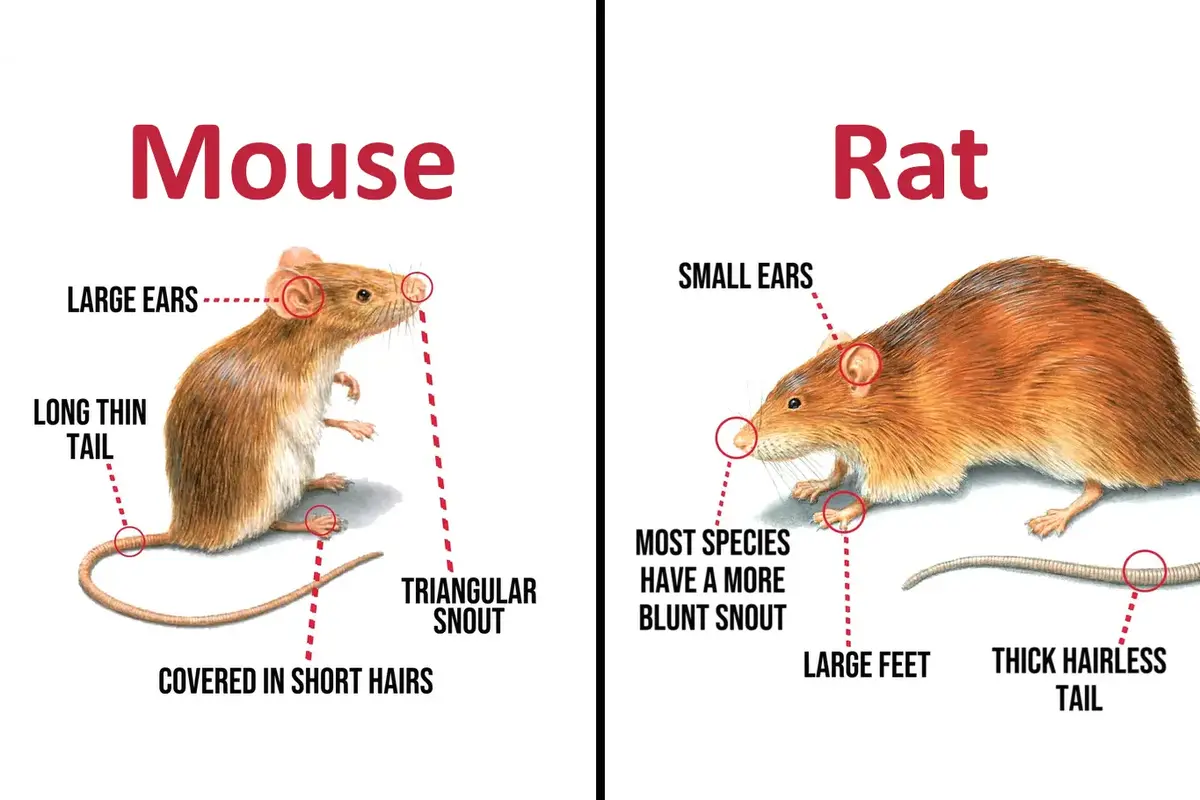
Most Twin Cities rodent problems involve one of three species. Getting the identification right is the first step in any rodent removal plan, because trap size, placement and the sealing materials all depend on it.
| Rodent | Size & look | Droppings | Where it shows up | Gap it can use |
|---|---|---|---|---|
| House mouse | 2.5–3.5 in. body, gray-brown, large ears, thin tail | Rice-sized, pointed ends, scattered | Kitchens, walls, ceilings, attics, garages | About 1/4 in. |
| Norway rat | 7–10 in. body, heavy, blunt nose, small ears | About 3/4 in., capsule-shaped, in piles | Basements, foundations, garages, alleys, yards | About 1/2 in. |
| Deer mouse | Brown back, bright white belly and feet, bicolor tail | Similar to house mouse | Cabins, garages, sheds, storage areas, edges of homes near open land | About 1/4 in. |
House mice account for most indoor calls. They nest close to food, breed quickly — a single female can have several litters a year — and travel inside walls along pipes and wires. Norway rats are ground-dwellers. They dig burrows along foundations, under slabs and beside garages, and usually enter through the lowest level of the building. Deer mice are less common inside city homes but matter because they are the main carrier of hantavirus in North America, which changes how droppings should be cleaned up. If you want the details, see our guides to the mouse exterminator service in Minneapolis and rat removal in Minneapolis.
Signs You Need Rodent Control in Your Minneapolis Home
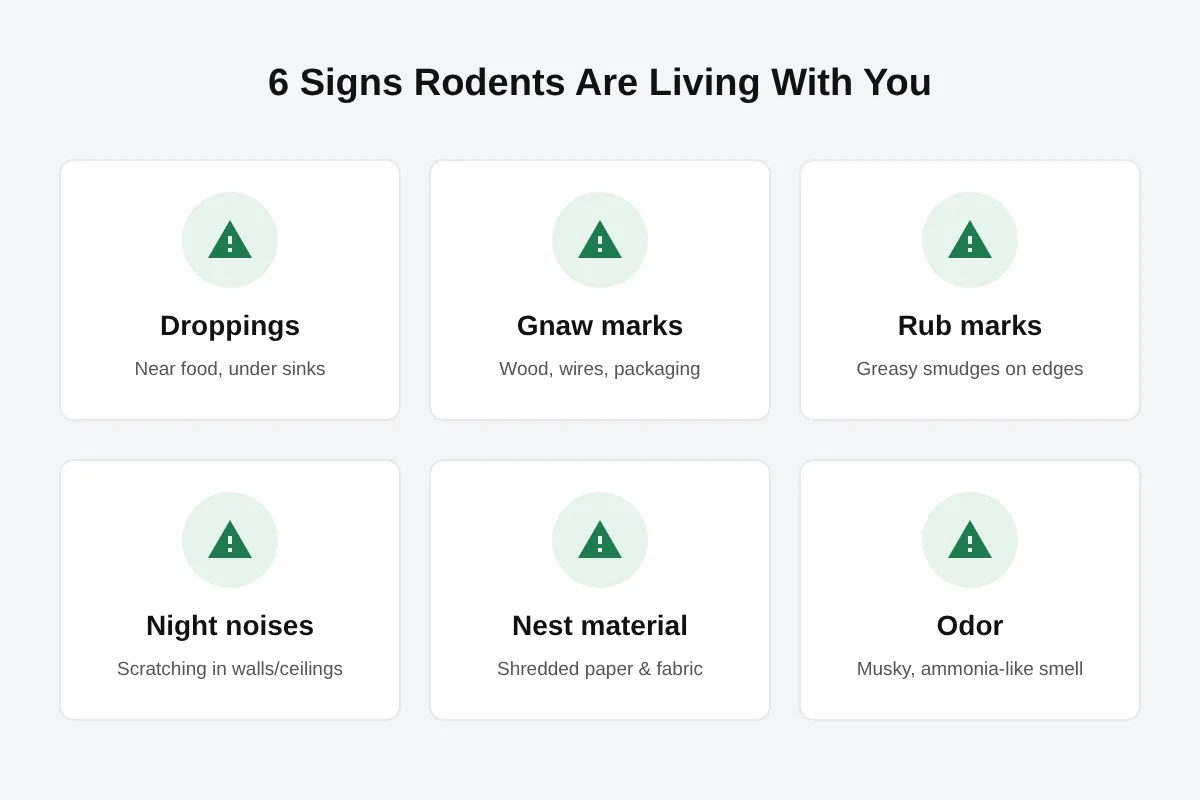
Mice and rats are mostly active at night, so many people never see one until the problem is well established. These clues usually show up first:
- Small dark droppings in drawers, under the sink, along baseboards or behind appliances
- Scratching, scurrying or gnawing in walls and ceilings, especially in the evening
- Chewed food packaging, pet food bags, cardboard boxes or stored clothing
- Shredded paper, insulation or fabric collected into a loose nest
- Greasy rub marks along walls, sill plates and pipes where rodents travel
- A musty, ammonia-like odor in a closet, cabinet or basement corner
- Fresh holes or burrows along the foundation, garage slab or under a deck
- Pets staring at, pawing at or barking at one spot on the wall
One sighting is rarely one mouse. If you have seen two or more of these signs, it is time to plan real rodent control rather than setting another trap and hoping. The mice and rats in walls page explains what is happening behind the drywall.
Where Mice and Rats Get Into Minneapolis Houses
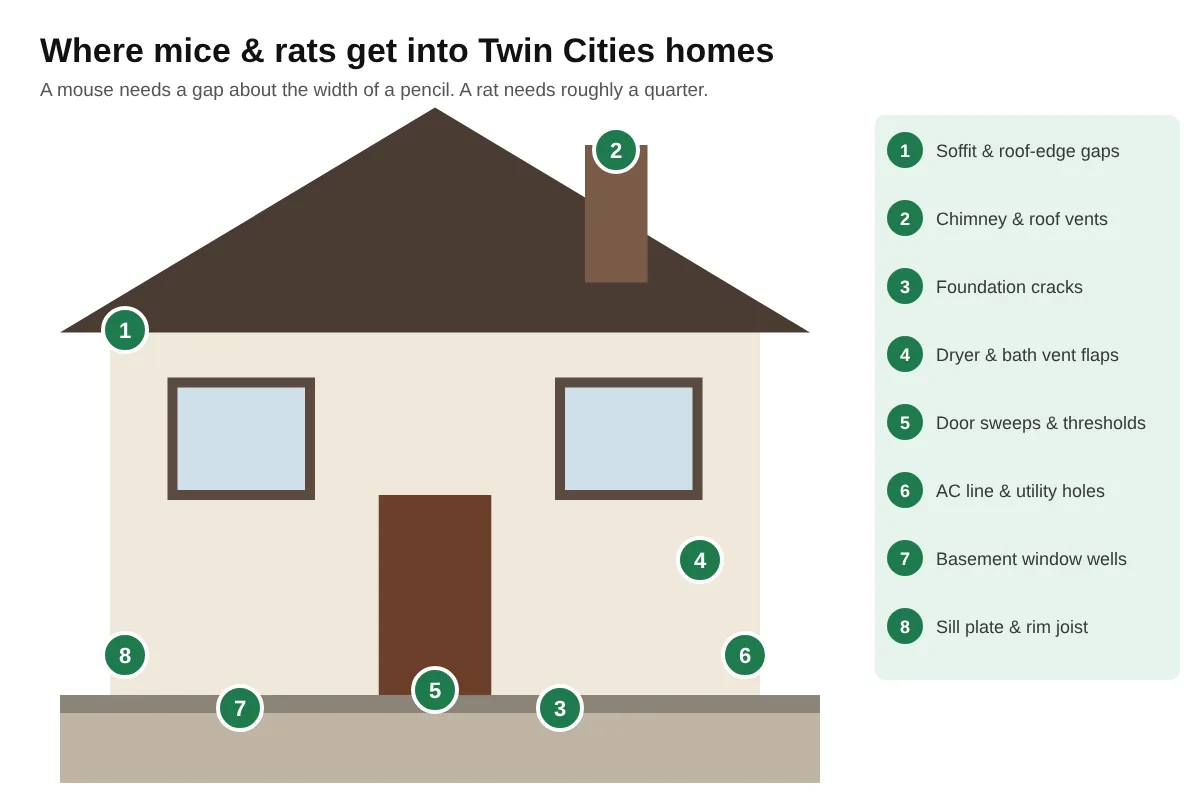
Every building has its own weak spots, but the openings are surprisingly predictable once you know the local housing.
Pre-1940 homes
Sill plates sitting on uneven fieldstone, gaps where old gas, water and electrical lines pass through the foundation, unscreened attic vents, and spaces under porches and three-season rooms.
Post-war ramblers and split-levels
Garage door corners and worn weatherstripping, dryer vents without guards, gaps around AC line sets, and the joint where an attached garage meets the house.
Newer homes, condos and apartments
Utility penetrations behind siding, shared walls and pipe chases between units, and soffit gaps left during construction.
A thorough provider checks all of these, inside and out, before suggesting a fix. That is the heart of rodent exclusion and mouse-proofing in Minneapolis.
What Professional Minneapolis Rodent Control Should Include
Whoever does the work, a complete job follows roughly the same six stages. If a quote skips the inspection or the sealing, ask why. You can read the full walk-through on our how it works page.
Conversation
You describe what you have seen, heard or smelled. The provider asks a few questions to judge the species, scale and urgency, then sets a visit.
Full inspection
Attic, living space, basement, garage and the entire exterior are checked. Droppings, rub marks, nests and every possible opening are noted, often with photos.
Written plan
You get the findings in plain language: what the rodent is, how it is getting in, what will be done and what it is expected to cost.
Removal
Traps are set along travel routes inside. Outdoors, locked bait stations may be used where they are appropriate and safe for kids and pets.
Exclusion
Entry points are sealed with chew-resistant materials and sealants that hold up through freeze-thaw cycles, from the foundation to the roof line.
Cleanup & follow-up
Droppings and nesting material are removed safely, problem areas are disinfected, and a return visit confirms the activity has stopped.
Rodent Control Services in Minneapolis, MN
One mouse in the pantry and a colony of rats under the garage slab are very different jobs. Each service below has its own page with local details, common questions and what the work involves.
Mouse Exterminator Minneapolis
Trapping, monitoring and sealing to clear house mice from kitchens, walls, basements and attics.
Rat Removal Minneapolis
Norway rat control for burrows, garages, alleys and basements, with foundation sealing to stop the next wave.
Urgent Rodent Removal
A rat in the kitchen or a mouse loose in the bedroom? What to do right now and how fast help can arrive.
Mice & Rats in Walls
Locating rodents behind drywall and plaster, removing them with minimal damage and closing their routes.
Attic Rodent Removal
Removing mice and rats from attics, cleaning up droppings and soiled insulation, and sealing the roof line.
Dead Rodent Removal & Odor
Finding the source of a dead-animal smell in walls, floors or vents, removing it and deodorizing the area.
Rodent Exclusion
Sealing foundation gaps, vents, garage doors and roof lines with materials mice and rats can’t chew through.
Commercial & Rental Properties
Ongoing programs for restaurants, warehouses, offices, landlords and property managers, with service records.
Your call connects you with an independent local pest control provider.
DIY Mouse Traps vs. Professional Rodent Removal
Plenty of Minneapolis homeowners start with a few snap traps from the hardware store, and for a single mouse in a garage that can work. The trouble starts when activity keeps coming back. Here is an honest comparison.
| Approach | What it does well | Where it falls short |
|---|---|---|
| Store-bought snap traps | Easy to try; catches a mouse or two | Mice avoid new objects; traps in the open miss the real travel routes; does nothing about entry points |
| Poison bait indoors | Kills rodents that eat it | Rodents often die inside walls and cause odor; risky for pets and children; new rodents keep arriving |
| Ultrasonic plug-ins | Easy to install | Little evidence of lasting results; rodents get used to the sound |
| Spray foam on gaps | Quick and inexpensive | Mice and rats chew straight through plain foam; it cracks in deep cold |
| Professional rodent control | Inspection, targeted removal, chew-proof sealing, safe cleanup and follow-up | Costs more up front, but is aimed at ending the problem instead of managing it |
The pattern we hear most often: traps catch a few mice in October, things go quiet, and by January the scratching is back. That is because nobody closed the door. If you are in that loop, read why mice keep coming back — it covers the seven most common reasons traps stop working.
Rodent Droppings, Hantavirus and Safe Cleanup
Rodents are more than a nuisance. Their droppings and urine can contaminate food and surfaces and spread illnesses such as salmonellosis and leptospirosis. Deer mice can carry hantavirus, which is rare in Minnesota but can cause a serious lung illness called hantavirus pulmonary syndrome when people breathe in dust from contaminated droppings or nests.
That is why cleanup matters as much as removal. The CDC’s hantavirus prevention guidance recommends airing out the space, wearing gloves, soaking droppings and nesting material with a disinfectant or bleach solution, and wiping them up rather than sweeping or vacuuming them dry.
Before you clean a cabin, garage or attic
- Open doors and windows for at least 30 minutes first
- Wear rubber or plastic gloves
- Spray droppings and nests until soaked; wait about 5 minutes
- Wipe up with paper towels and bag the waste
- Disinfect the area, then wash gloved hands
Heavy contamination, attic insulation or crawl spaces are better left to a provider with proper protective gear. Our hantavirus safety guide goes deeper.
Rodent Problems for Homes and Businesses — and How They Get Solved
The pain points are different depending on who you are. Here is what we hear from callers across the city, and what the fix usually looks like.
Homeowners
The worry: droppings near food, kids and pets, noises at night, damage to wiring and insulation, and not knowing how many are inside.
The fix: a whole-house inspection, quiet indoor trapping instead of poison, sealing the gaps you can’t see from the ground, and cleanup of the attic or basement where they nested.
Renters & Condo Owners
The worry: mice moving between units, a landlord who is slow to act, and not being allowed to make repairs yourself.
The fix: documenting the signs with dates and photos, bringing in the property owner, and treating shared walls and pipe chases as one connected problem rather than unit by unit.
Restaurants & Food Businesses
The worry: health inspections, a sighting in front of customers, contaminated stock and the reputational cost of a single photo online.
The fix: scheduled monitoring, exterior bait stations where allowed, sealing at loading docks and utility entries, and written service records you can show an inspector. Our restaurant rodent prevention checklist is a good starting point.
Landlords, Warehouses & Offices
The worry: tenant complaints, damaged inventory, chewed wiring and repeat callbacks across multiple buildings.
The fix: a property-wide plan instead of one-off visits, exclusion at dock doors and foundations, and regular reporting. See commercial rodent control in Minneapolis for details.
A Season-by-Season Rodent Calendar for Minneapolis
Rodent activity in the Twin Cities follows the weather. Knowing what each season brings helps you act before a small problem becomes a big one.
Fall (Sept–Nov)
The big push indoors. Mice start testing foundations and garage doors with the first cold nights. This is the ideal time to seal — our fall mouse-proofing checklist walks through it.
Winter (Dec–Feb)
Rodents already inside settle into walls, attics and basements and start breeding. Cars parked outside become shelters too — see how to keep mice out of your car engine.
Spring (Mar–May)
Snowmelt reveals burrows, chewed hoses and droppings in garages and cabins. Spring cleaning is when many people discover a winter infestation.
Summer (Jun–Aug)
Norway rats are most active outdoors, around alleys, compost, bird feeders, decks and garden beds. It is the right time to repair foundations and grade soil away from the house.
What Affects the Cost of Rodent Control in Minneapolis?
Every quote depends on what the inspection finds, so a fair price can only be given after someone has looked at the building. The main factors are:
- Species and size of the infestation
- Size, age and construction of the building
- Number and location of entry points to seal
- Attic or crawl-space cleanup and insulation work
- Number of follow-up visits or ongoing monitoring
Ask for a written scope that separates removal, exclusion and cleanup so you can compare quotes fairly. Our rodent control cost factors page explains each one.
Minneapolis Neighborhoods We Hear From Most
Requests come from every corner of the city. In Longfellow, Nokomis, Seward and Standish, older bungalows near Minnehaha Creek and the river see heavy fall mouse traffic. North Minneapolis, Camden and Near North deal with Norway rats along alleys and garages. Northeast, Marcy-Holmes and Dinkytown have older duplexes and student rentals with shared walls. Uptown, Whittier, Lyndale and Phillips mix apartments, restaurants and dense alleys, while Linden Hills, Kingfield and Tangletown near the Chain of Lakes see mice in attics and garages.
Wherever you are, the approach is the same: find out why rodents chose your building, then take that reason away.
Rodent Control Across Minneapolis and Nearby Suburbs
Rodents don’t stop at the city limits, and neither does our referral network. Each community below has its own page with local details. You can also browse every service area.
St. Paul
Historic homes near the Mississippi and busy commercial corridors keep rodent pressure steady.
Bloomington
Ramblers and split-levels near the Minnesota River bottoms see strong fall mouse activity.
St. Louis Park
A blend of 1950s homes and new apartments, each with different weak spots.
Richfield
Post-war homes with attached garages are a common entry route for mice.
Brooklyn Park
Newer neighborhoods next to fields and open land get deer mice and field mice.
Edina
Larger homes and finished basements where discreet, thorough work matters.
Brooklyn Center
Homes and rentals near Shingle Creek with steady rat and mouse pressure.
Fridley
Riverside homes and businesses near Rice Creek and the Mississippi.
How Norvane Helps You Find Local Rodent Control
Norvane Rodent Control is a referral service, not a pest control company. We built this site to explain rodent problems clearly and to make it easier to reach an independent local provider who does the work. Providers set their own prices, schedules and terms, and you decide whether to hire them.
That independence is why we encourage you to ask good questions. A provider who is confident in their work will be happy to answer them. Learn more about Norvane or read our referral disclosure.
Questions worth asking any provider
- Will you inspect the whole building, including the exterior and attic?
- Which entry points did you find, and how will each be sealed?
- Do you use traps or bait indoors, and why?
- Is cleanup of droppings and insulation included or separate?
- How many follow-up visits are included, and what happens if activity continues?
- Can I get the plan and the price in writing?
Rodent Control Minneapolis FAQs
Straight answers to the questions Minneapolis homeowners and business owners ask most. More answers are on our rodent control FAQ page.
How long does rodent control take in a Minneapolis home?
Most homes see a sharp drop in activity within the first week once trapping begins along the right routes. A complete job, including sealing and a follow-up check, usually takes one to three weeks. Larger buildings, rat burrows or heavy attic contamination can take longer.
Is it mice or rats in my walls?
Droppings are the quickest clue. Mouse droppings are about the size of a grain of rice and scattered; rat droppings are closer to 3/4 inch and often found in groups. Mice tend to be heard in walls and ceilings on upper floors, while rats usually stay low, in basements, crawl spaces and garages.
Should poison be used inside the house?
Generally no. Poisoned rodents often die inside walls or under floors, which leads to odor problems, and bait can be a risk to pets and children. Indoors, traps plus exclusion is the safer and more predictable approach. Locked bait stations are usually kept outside.
Can I just seal the holes myself?
You can, and small gaps around a pipe are a reasonable DIY job. The catch is finding all of them and using the right materials. Plain spray foam and caulk get chewed through, and sealing before the rodents inside are removed can trap them in the walls. A provider will usually remove, then seal.
Is it safe to clean up mouse droppings myself?
For small amounts, yes, if you follow the wet-cleaning method: ventilate, wear gloves, soak with disinfectant, wipe and bag. Never sweep or vacuum dry droppings. For attics, crawl spaces or cabins with heavy contamination, professional cleanup is the safer choice.
Why do I get mice every fall even after trapping?
Because the entry points are still open. Trapping removes the mice inside, but each fall a new group follows the same scent trails to the same gaps. Exclusion — sealing the building with chew-proof materials — is what breaks the cycle.
Who do I contact about rats in my alley or a neighbor’s yard?
Rodent problems on public property or neglected neighboring properties can be reported to Minneapolis 311, which routes concerns to city health inspectors. Rodents in or under your own building are the property owner’s responsibility to address.
Rodent Control Tips for Minneapolis Homes
Want to do more on your own? These practical guides from our rodent control blog are written for Twin Cities homes and businesses.
How to Mouse-Proof Your Minneapolis Home Before Winter
A fall checklist for sealing the gaps mice use first.
Why Do Mice Keep Coming Back?
Seven reasons traps stop working and what to do instead.
Mice in Your Car Engine?
Protecting your vehicle through a Minnesota winter.
Restaurant Rodent Prevention Checklist
Practical steps for Twin Cities food businesses.
Your call connects you with an independent local pest control provider.